• 3 min read
Code Execution Vulnerability
Discovered in OpenAI Codex Desktop
A critical security vulnerability has been identified in OpenAI Codex: an attacker can bypass permission validation and achieve remote code execution (RCE) simply by inducing a user to open a folder.
 AUTOSEC.DEV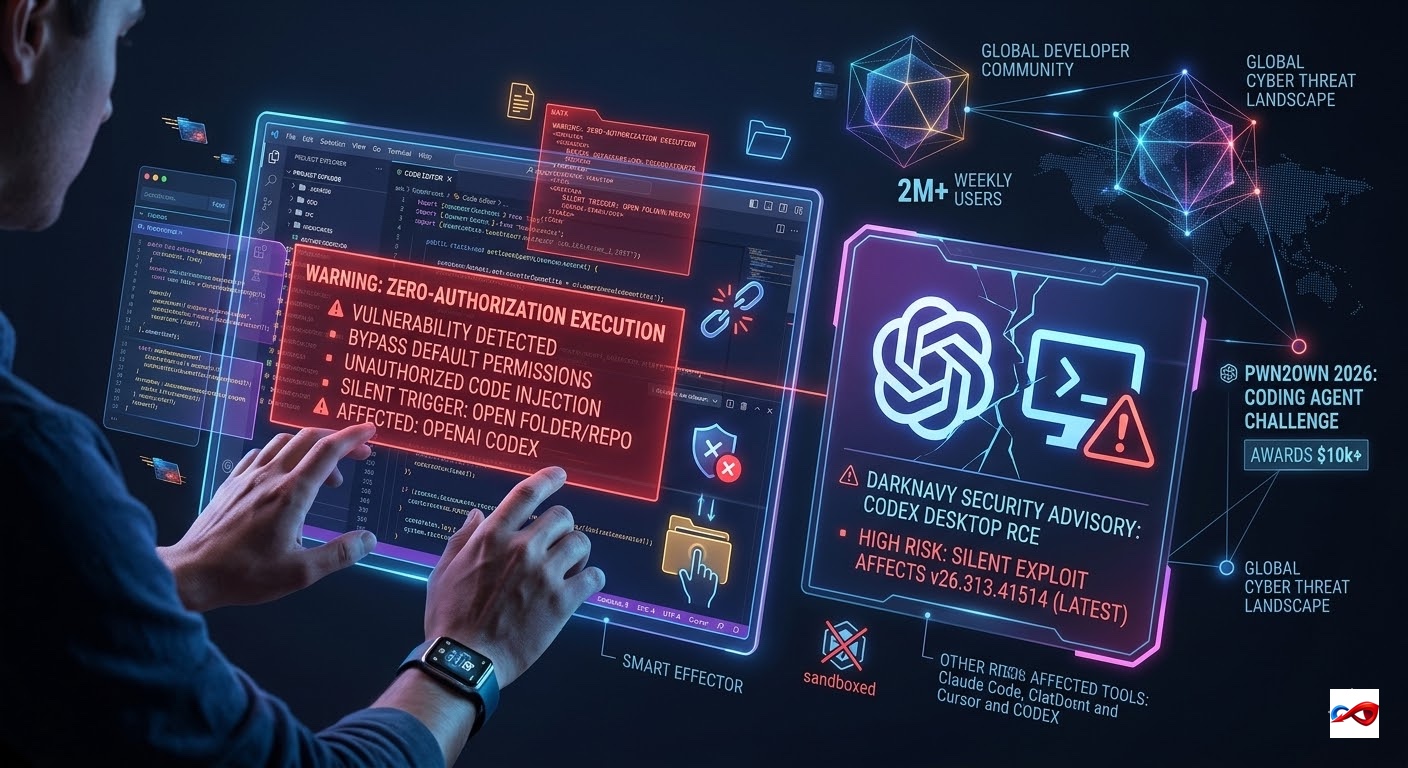
- Release Date: March 17, 2026
- Risk Level: Critical
- CVE ID: N/A
- Vulnerability Category: Remote Code Execution (RCE)
Affected Scope
- Affected Product: OpenAI Codex Desktop
- Confirmed Version: 26.313.41514 (1043) and earlier
- User Base: Over 2 million developers and enterprise users worldwide utilizing Codex for automated programming.
Vulnerability Details
Discovered by the DARKNAVY security team, this vulnerability represents a significant threat by bypassing the default security boundaries of AI Agent applications:
- Permission Mechanism Failure: The exploit successfully bypasses the Codex Default Permission model. Local commands that previously required explicit user consent ("Allow") can now be triggered directly.
- "Zero-Authorization" Silent Execution: Attackers can trigger an exploit simply by inducing a user to perform the routine action of "Opening a Project" via a specially crafted malicious code repository or folder.
- Indistinguishable Attack Chain: The entire exploitation process occurs without any system pop-ups or authorization prompts. Malicious code runs silently in the background, leaving the user completely unaware of the compromise.
- Data Security Risks: This flaw allows attackers to exfiltrate source code, sensitive environment variables (such as API Keys), or achieve further lateral movement within the development system.
Mitigation Recommendations
- Strictly Audit External Projects: Until a patch is available, do not use Codex to directly open any third-party open-source repositories or folders from untrusted or unverified sources.
- Strengthen Environment Isolation: Open unaudited external project files only within a sandbox environment, virtual machine (VM), or container to physically or logically isolate potential risks.
- Social Engineering Awareness: Maintain high vigilance against unsolicited compressed archives or project links shared via email or developer communities.
- Monitor Cross-Platform Risks: Given that mainstream tools like Claude Code and Cursor face similar security challenges, exercise extreme caution before selecting "Trust Workspace" for any directory.
AUTOSEC.DEV Solution: Building a 360-Degree Defense
- Secure Code Review: To defend against NPM supply chain poisoning, we combine automated static analysis with expert manual review to thoroughly assess your application's source code and third-party dependencies. We identify malicious packages, hidden backdoors, and logic errors introduced by attackers, eliminating security risks at the development stage before they compromise developer environments or production systems.
- Security Awareness Training & Phishing Simulation : FAMOUS CHOLLIMA heavily relies on social engineering—such as fake job interviews or fraudulent coding tasks—to trick developers into downloading poisoned NPM packages. We design realistic phishing campaigns and deliver role-based security training to measure and improve developer susceptibility, establishing a strong "human firewall" against targeted social engineering attacks.
- End-to-End Incident Response (IR): In an emergency, every second of confusion amplifies the loss. AUTOSEC.DEV provides standardized SOPs (Standard Operating Procedures) and rapid response services tailored to specific business needs to help projects mitigate losses quickly.