Security Alert: North Korean Threat Actor
FAMOUS CHOLLIMA Releases 26 Malicious npm Packages
Security researchers have detected a large-scale supply chain attack on the official npm registry orchestrated by the North Korean-linked threat group **FAMOUS CHOLLIMA** (also known as LabP2P). The group released at least **26 malicious packages** masquerading as legitimate development tools. These packages utilize `install.js` scripts to automatically trigger Remote Access Trojans (RATs) upon installation, aiming to exfiltrate developers' SSH keys, Git repositories, browser credentials, and sensitive clipboard data.
 AUTOSEC.DEV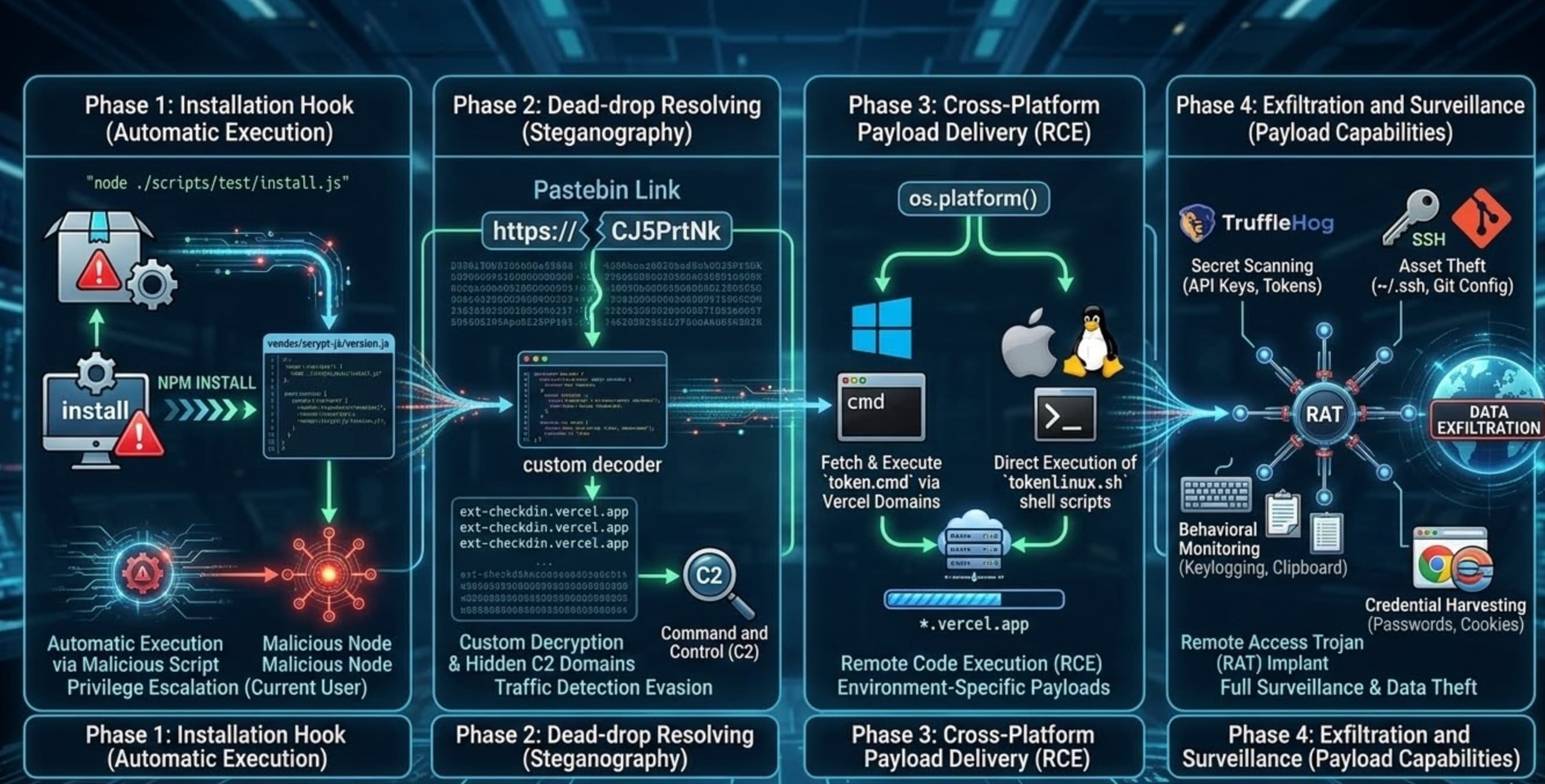
- Release Date: March 3, 2026
- Risk Level: Critical
- CVE ID: N/A
- Vulnerability Category: Supply Chain Attack
Affected Scope
Vulnerability Details
Phase 1: Installation Hook (Automatic Execution)
All affected packages contain a malicious install script: "node ./scripts/test/install.js". By default, npm executes this script with the current user's privileges during the installation process, which subsequently invokes core malicious code hidden within vendor/scrypt-js/version.js.
Phase 2: Dead-drop Resolving (Steganography)
The malicious code downloads seemingly legitimate text from Pastebin links (e.g., CJ5PrtNk) and uses a custom decoder to extract hidden Command and Control (C2) domains. This steganographic technique is highly effective at evading static traffic detection.
Payload Download Addresses:
ext-checkdin.vercel.app
cleverstack-ext301.vercel.app
cleverstack-app998.vercel.app
brightlaunch-ext742.vercel.app
brightlaunch-app615.vercel.app
primevector-ext483.vercel.app
primevector-app920.vercel.app
zenithflow-ext156.vercel.app
zenithflow-app877.vercel.app
cloudharbor-ext664.vercel.app
cloudharbor-app239.vercel.app
sparkforge-ext518.vercel.app
sparkforge-app790.vercel.app
logicfield-ext432.vercel.app
logicfield-app681.vercel.app
atlasnode-ext957.vercel.app
atlasnode-app204.vercel.app
signalbase-ext369.vercel.app
signalbase-app845.vercel.app
neuraldock-ext126.vercel.app
neuraldock-app734.vercel.app
orbitstack-ext592.vercel.app
orbitstack-app318.vercel.app
fusionlayer-ext807.vercel.app
fusionlayer-app463.vercel.app
quantapath-ext275.vercel.app
quantapath-app914.vercel.app
visiondock-ext648.vercel.app
visiondock-app157.vercel.app
openmatrix-ext539.vercel.app
openmatrix-app882.vercel.app
Phase 3: Cross-Platform Payload Delivery (RCE)
After identifying the environment via os.platform(), the script uses curl or wget to fetch targeted payloads from *.vercel.app domains:
- Windows: Executes a
cmdscript to silently download and runtoken.cmd. - macOS/Linux: Uses a
bashpipe to directly execute remote shell scripts (e.g.,tokenlinux.sh).
Phase 4: Exfiltration and Surveillance (Payload Capabilities) The final Remote Access Trojan (RAT) implant possesses the following malicious capabilities:
- Secret Scanning: Integrates TruffleHog to scan code for sensitive secrets (API Keys, Tokens).
- Asset Theft: Extracts SSH keys (
~/.ssh) and Git configuration files. - Behavioral Monitoring: Performs keylogging and captures real-time clipboard contents.
- Credential Harvesting: Exports saved usernames, passwords, and cookies from web browsers.
Remediation Recommendations
- Complete Uninstallation: Run
npm uninstall <malicious_package_name>and manually delete the entirenode_modulesdirectory to ensure no artifacts remain. - Persistence Cleanup:
- Unix/macOS: Check for and delete
$HOME/.config/tokenlinux.shor$HOME/Library/tokenlinux.sh. - Windows: Check for and delete
%APPDATA%\token.cmd.
- Unix/macOS: Check for and delete
- Credential Rotation: Given the keylogging and credential-stealing capabilities of this RAT, affected users must immediately rotate Git Access Tokens, SSH Private Keys, Cloud Service API Keys, and any sensitive passwords stored in browsers.
AUTOSEC.DEV Solution: Building a 360-Degree Defense
- Secure Code Review: To defend against NPM supply chain poisoning, we combine automated static analysis with expert manual review to thoroughly assess your application's source code and third-party dependencies. We identify malicious packages, hidden backdoors, and logic errors introduced by attackers, eliminating security risks at the development stage before they compromise developer environments or production systems.
- Security Awareness Training & Phishing Simulation : FAMOUS CHOLLIMA heavily relies on social engineering—such as fake job interviews or fraudulent coding tasks—to trick developers into downloading poisoned NPM packages. We design realistic phishing campaigns and deliver role-based security training to measure and improve developer susceptibility, establishing a strong "human firewall" against targeted social engineering attacks.
- End-to-End Incident Response (IR): In an emergency, every second of confusion amplifies the loss. AUTOSEC.DEV provides standardized SOPs (Standard Operating Procedures) and rapid response services tailored to specific business needs to help projects mitigate losses quickly.