Humanity Protocol H Token Exploit:
Foundation Key Compromise Triggers $32M Drain and 90% Crash
Humanity Protocol's H token collapsed after a reported foundation-member private-key compromise led to an ongoing drain of H-linked wallets, with public estimates placing losses above $30M and large amounts swapped into ETH.
 AUTOSEC.DEV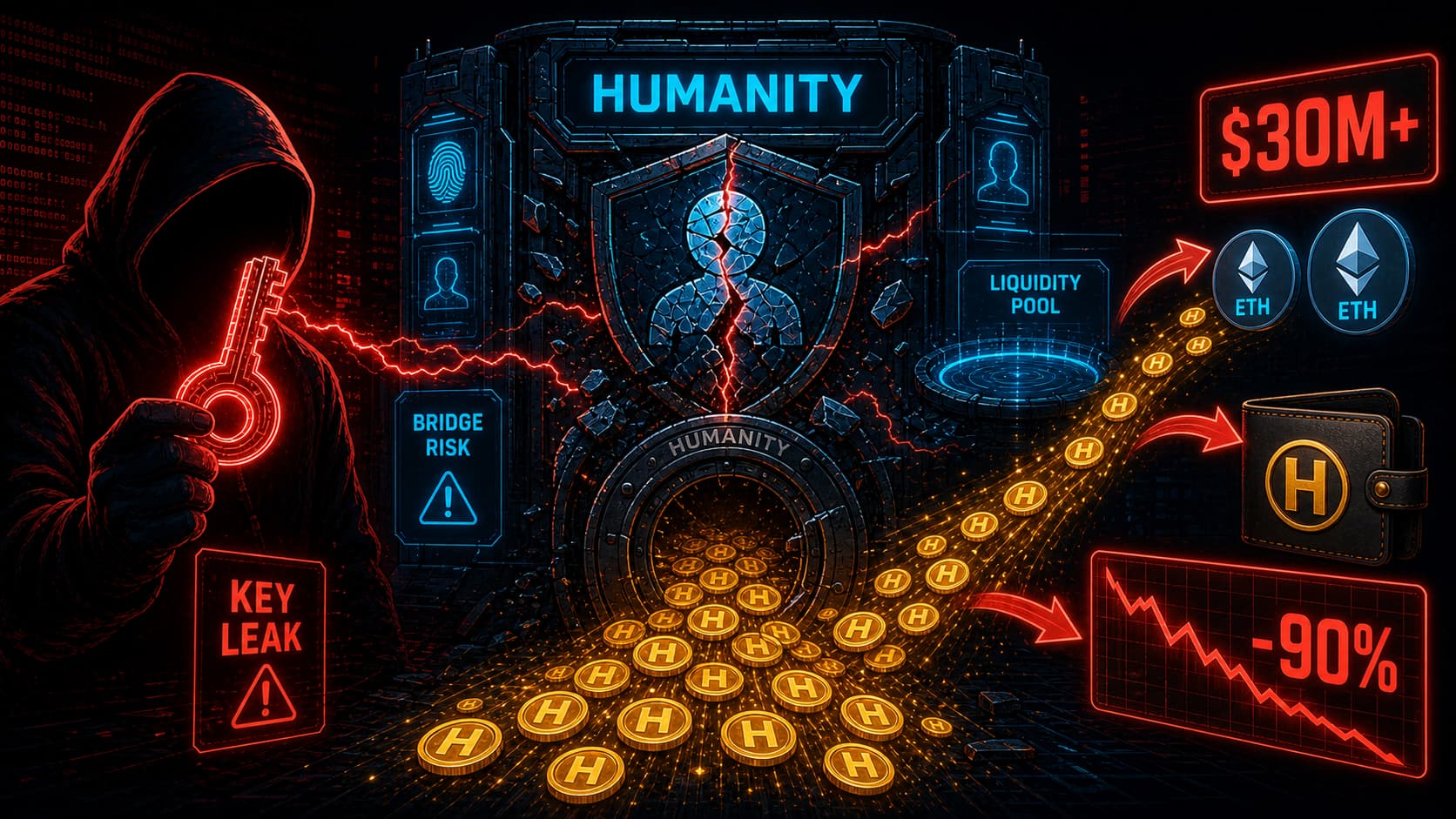
- Incident Date: June 9, 2026
- Target: Humanity Protocol / H token holders and related liquidity routes
- Target Overview: Humanity Protocol is a decentralized identity project using biometrics and zero-knowledge proofs to support proof-of-humanity style verification. Its H token is listed across Ethereum and BNB Chain venues.
- Official Alert: Humanity Protocol's official X account published an incident warning on June 9, 2026. Public reporting also said Humanity founder Terence Kwok attributed the breach to a compromised private key belonging to a Humanity Foundation member.
- Affected Wallets: Public on-chain reporting cited by The Block said about 17 wallets that had interacted with Humanity Protocol were drained.
- Reported Loss: Phemex described the incident as an exploit of over $30 million. The Block reported that public on-chain estimates widened to about $32 million.
- Reported Fund Flow: The Block reported that roughly $23.7 million of the stolen amount had been swapped for ETH, while about $7.9 million remained in H tokens.
- Market Impact: Public reports described an approximately 89%-90% H token drop after the exploit became public.
- User Safety Guidance: Public reporting said users were warned not to interact with the Humanity bridge or liquidity pools while the incident remained under investigation.
- Attack Vector: Private-Key Compromise / Foundation Member Key Exposure / Token Dumping / Wallet Drain / Bridge and Liquidity-Pool Risk
Incident Review & Technical Details
1. Attack Path
- A Foundation-Linked Private Key Was Reportedly Compromised: Public reporting attributed the breach to a private-key compromise involving a Humanity Foundation member. No reviewed source provided a final forensic report proving the exact key-custody failure path.
- H-Linked Wallets Were Targeted: The Block reported that on-chain analyst Specter flagged about 17 wallets holding H token that had interacted with Humanity Protocol as affected by an ongoing exploit.
- Loss Estimates Expanded Quickly: Initial public estimates reportedly started lower and then widened. Phemex framed the incident as over $30 million, while The Block cited an updated estimate of about $32 million.
- The Attacker Converted a Large Portion to ETH: The Block reported that approximately $23.7 million had already been swapped for ETH, with roughly $7.9 million still held as H tokens at the time of its report.
- H Token Liquidity Was Hit Directly: Large forced sales of H pushed sell pressure into available liquidity, and public reports described an 89%-90% collapse in the token price.
- Users Were Told to Avoid Risky Interaction Surfaces: Public reporting said the team warned users not to interact with the bridge or liquidity pools while containment and investigation continued.
- Final Technical Details Remain Pending: At the time of writing, reviewed sources did not include a full attacker address list, root-cause report, exchange freeze status, bridge patch report, or final user remediation plan.
2. Impact Scope
- Direct Economic Impact: Public estimates placed the loss above $30 million, with one cited on-chain update reaching about $32 million.
- Affected Assets: H token, with a large portion of the stolen value reportedly swapped into ETH.
- Affected Users or Wallets: The most specific public count reviewed was about 17 affected wallets linked to prior Humanity Protocol interaction.
- Market Damage: H reportedly dropped roughly 89%-90% after the exploit and token-dumping activity became public.
- Bridge and LP Exposure: The team reportedly warned against bridge and liquidity-pool interaction during the active incident window. That warning should be treated as an operational containment signal even if the final exploit path did not originate in bridge code.
- Unaffected Components: Reviewed sources did not prove an Ethereum or BNB Chain consensus issue. The strongest public root-cause framing points to key compromise rather than a base-chain failure.
- Disclosure Gap: The exact key owner, custody environment, signing history, attacker address set, and whether any smart-contract permissions were abused remain unresolved until a final postmortem is published.
3. Root Cause Assessment
This incident is best understood as a privileged-key and operational-security failure rather than a confirmed protocol-consensus or token-contract bug. A foundation member's private key can be a direct systemic risk if it controls treasury assets, bridge permissions, liquidity operations, market-making wallets, token allocations, or operational hot wallets.
Key risk patterns to examine:
- Foundation Keys Can Behave Like Protocol Keys: Even if a key is not a contract owner, it can still hold market-moving token balances or operational permissions.
- Wallet Clustering Creates Shared Exposure: If multiple wallets use the same custody workflow, signer device, seed-backup process, browser profile, or operational tooling, one compromise can cascade.
- Token Dumping Converts Key Theft Into Market Loss: Stolen H could be sold into liquidity immediately, transferring damage from the compromised wallets into holders and LPs through price collapse.
- Bridge and LP Warnings Suggest Wider Blast-Radius Concern: During uncertain containment, any bridge, pool, market-making, or routing path connected to the asset can become part of the attacker exit surface.
- Response Speed Matters More Than Root-Cause Certainty: When an attacker is actively converting tokens to ETH, teams need address labeling, exchange coordination, routing restrictions, and user warnings before a polished final report exists.
The core invariant should be operational as much as technical: no single foundation hot key should be able to expose market-moving H balances, liquidity operations, or bridge-adjacent permissions without multi-signature controls, segregation, monitoring, and rapid revocation paths.
4. Mitigation and Response
Recommended actions for Humanity-style token ecosystems, foundations, and identity protocols:
- Immediately revoke, rotate, or quarantine any foundation, treasury, market-making, bridge-operator, LP-manager, or admin key suspected of exposure.
- Publish the affected wallet set, attacker addresses, bridge and LP risk status, revoked permissions, and exchange coordination status as soon as facts are verified.
- Move remaining foundation-held H and operational assets into fresh multi-signature custody with hardware-backed signers and segregated signer devices.
- Freeze or pause bridge and liquidity-pool operations if any compromised key can influence routing, liquidity withdrawal, bridge mint/release, or treasury movements.
- Coordinate with exchanges, bridges, DEX frontends, and analytics providers to label attacker wallets and monitor ETH conversion routes.
- Add alerts for large H transfers, abnormal wallet drains, bridge withdrawals, LP removals, large swaps into ETH, new approvals from foundation wallets, and sudden signer activity.
- Run a full key-custody investigation covering seed storage, browser extensions, signing machines, cloud backups, CI/CD secrets, phishing exposure, and access logs.
- Convert the incident into tabletop drills and automated response playbooks for token-dumping events, active wallet drains, and exchange-freeze coordination.
- Publish a final postmortem that separates confirmed facts from estimates: root cause, affected keys, wallet list, fund flow, containment actions, recovery status, and user remediation.
AUTOSEC.DEV Solution: Building a 360-Degree Defense
The Humanity Protocol incident shows that token security is not only smart-contract security. Foundation custody, market-making wallets, bridge operators, and liquidity managers are all part of the live attack surface.
- Key-Custody and Operations Review: AUTOSEC.DEV reviews signer workflows, multisig thresholds, hardware-wallet use, seed backup procedures, privileged wallet segregation, and emergency revocation paths.
- Token and Liquidity Risk Assessment: We model how compromised wallets can create token dumping, LP drain risk, bridge exposure, market-maker compromise, and cascading holder losses.
- On-Chain Monitoring and Response Playbooks: We build alerts for abnormal transfers, approval spikes, liquidity removals, bridge interactions, CEX deposits, ETH conversion, and attacker address clustering.
- Incident Response (IR): AUTOSEC.DEV supports fund-flow tracing, exchange and bridge coordination, emergency key rotation, user-facing risk communication, and post-incident hardening.
Service Content
- AUTOSEC.DEV - Secure Code Review
- AUTOSEC.DEV - Penetration Testing
- AUTOSEC.DEV - Incident Response Service