Syscoin Bridge Exploit: 5B Unauthorized
SYS Minted via Transaction-Proof Validation Flaw
Syscoin paused its bridge after a transaction-proof validation flaw caused the bridge relay path to accept a malicious proof and create about 5B unauthorized SYS through the UTXO bridge path.
 AUTOSEC.DEV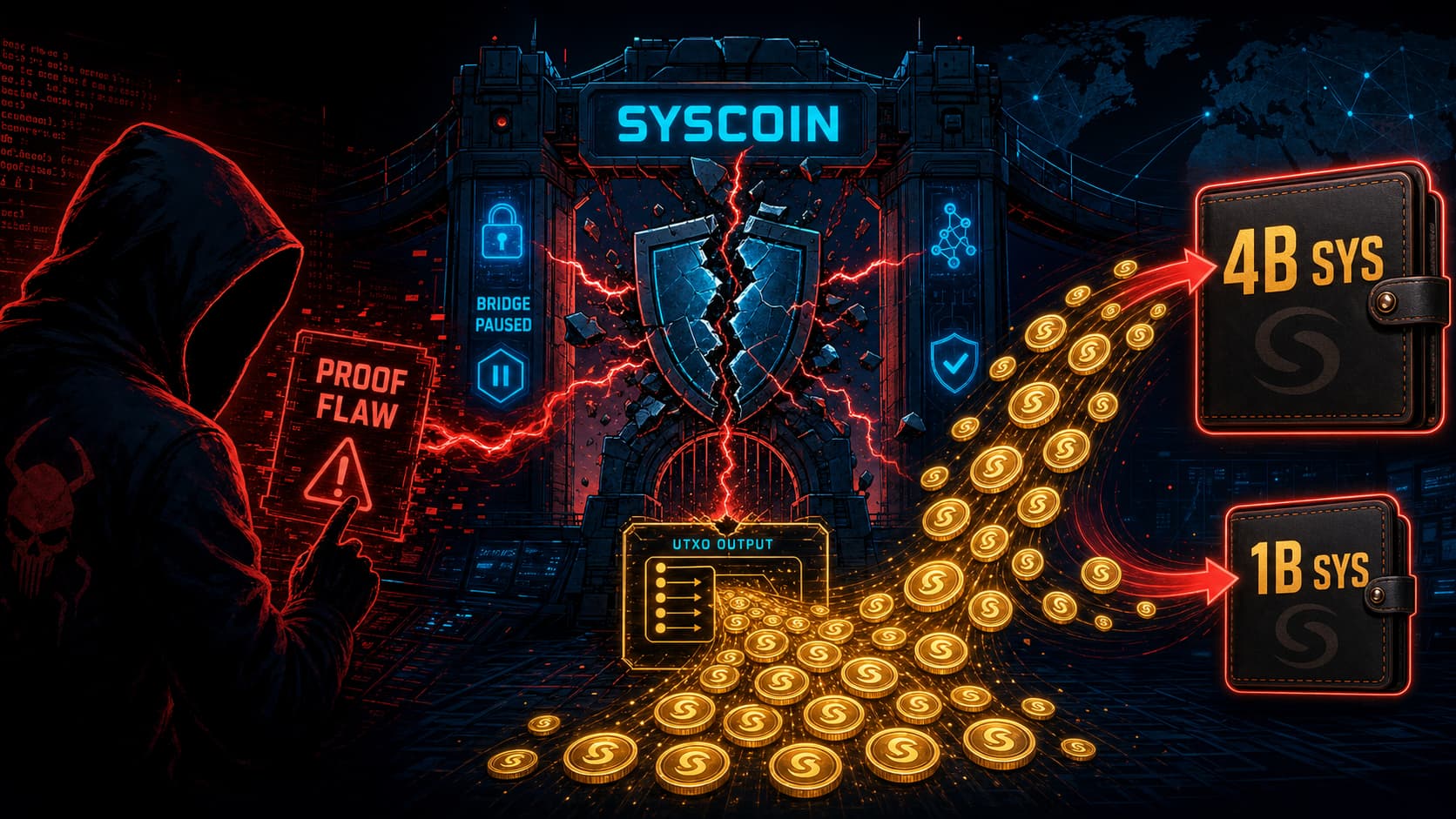
- Incident Date: June 8, 2026
- Target: Syscoin Bridge / Syscoin native UTXO bridge path
- Target Overview: Syscoin is a blockchain ecosystem with native bridge infrastructure. The reported incident affected the bridge proof-verification and relay path, not the custody of user wallets or a Syscoin private-key compromise.
- Official Disclosure: Syscoin published a preliminary postmortem on X describing a bridge incident involving approximately 5B SYS.
- Unauthorized Output: Approximately 5 billion SYS were created through the UTXO bridge path.
- Reported Fund Split: Public reporting said the unauthorized output was first sent to a UTXO address and later split, with two largest tainted balances holding roughly 4B SYS and 1B SYS.
- Bridge Status: Bridge operations were paused while the team investigated, finalized the fix, and determined how to neutralize the unauthorized output.
- Market Impact: Public reports described a sharp SYS sell-off after the incident. AMBCrypto reported SYS trading near $0.0016 at press time and valued the unauthorized 5B SYS output at roughly $8 million at that price.
- Attack Vector: Transaction-Proof Validation Failure / Bridge Relay Proof Misinterpretation / Unauthorized Supply Creation / Cross-Chain Bridge Logic Flaw
Incident Review & Technical Details
1. Attack Path
- The Bridge Relay Path Accepted a Bad Proof: According to Syscoin's preliminary explanation quoted by public reports, the bridge relay path incorrectly accepted or interpreted a transaction proof.
- A Manipulated Transaction Was Treated as Valid: The failure was reported as a validation flaw in the bridge's proof-verification process. The bridge system treated a fraudulent transaction as legitimate instead of rejecting it.
- Unauthorized SYS Was Created on the UTXO Bridge Path: The invalid acceptance caused the bridge to create an unauthorized SYS output of approximately 5B SYS through the UTXO bridge path.
- The Output Was Split Into Tainted Balances: Public reporting said the unauthorized SYS was initially sent to a UTXO address and then split into additional outputs, with two largest tainted balances holding roughly 4B SYS and 1B SYS.
- No Private-Key Compromise Was Reported: The available sources state that Syscoin attributed the incident to a bridge validation failure rather than compromised user wallets, accounts, or private keys.
- The Bridge Was Paused During Remediation: Syscoin paused bridge operations while investigating, reviewing the fix, and determining the correct process to rectify or neutralize the unauthorized supply impact.
2. Impact Scope
- Supply Integrity Risk: The core damage was unauthorized supply creation. Even if the tainted outputs are restricted, the incident directly challenged the bridge's ability to preserve canonical SYS supply.
- Bridge Availability Impact: Syscoin urged users not to interact with the bridge while services remained suspended.
- Affected Component: The reported affected component was the bridge relay and transaction-proof validation path, especially the UTXO bridge output path.
- Affected Assets: SYS, through unauthorized output creation and market-confidence damage.
- Market Reaction: Public reports described a sharp decline in SYS after disclosure. Because the final remediation path was not complete at the time of reporting, market impact should be treated separately from final realized loss.
- Containment Surface: Syscoin reportedly contacted exchanges, infrastructure providers, and ecosystem partners to help blacklist, freeze, or closely monitor deposits connected to the tainted UTXO trail.
- Disclosure Gap: The final technical root cause, exact vulnerable validation condition, patch diff, attacker transaction set, and definitive remediation process were not fully available in the reviewed sources.
3. Root Cause Assessment
This incident is best understood as a bridge proof-verification failure, not a conventional hot-wallet drain. A bridge is only as safe as the logic that decides whether an external transaction, output, proof, or message is valid. If that logic incorrectly parses or accepts malicious proof data, the bridge can mint or release assets without a legitimate source event.
Key risk patterns to examine:
- Parsing and Semantic Validation Diverged: A proof may be syntactically acceptable while still failing the semantic requirements that bind it to one exact source transaction, amount, recipient, output, and chain context.
- External State Was Treated as Canonical Too Early: Cross-chain systems often convert remote evidence into local asset movement. Any ambiguous proof boundary becomes a supply-control boundary.
- UTXO Output Handling Needs Strict Uniqueness: UTXO-style paths require exact checks for transaction identity, output index, confirmation/finality, amount, recipient, and one-time consumption.
- Replay and Domain Separation Must Be Explicit: Proofs should be bound to chain ID, bridge instance, asset, direction, nonce or output index, and verification version so old or foreign data cannot be interpreted in the wrong context.
- Monitoring Must Treat Mint-Like Events as Critical: A bridge-created output of billions of SYS should trigger immediate circuit breakers, deposit restrictions, and exchange coordination before tainted funds can spread.
The core invariant should have been strict: no bridge relay path should create SYS unless the submitted proof uniquely maps to a finalized, unspent, domain-correct source event that has not already been consumed by the bridge.
4. Mitigation and Response
Recommended actions for Syscoin-style bridge systems and cross-chain infrastructure teams:
- Keep the bridge paused until the vulnerable validation path, patch implementation, and remediation process have passed independent review.
- Reconstruct the malicious proof and all related UTXO movements, then convert them into regression tests that fail against the old verifier and pass against the patched verifier.
- Add explicit checks for source chain, bridge direction, transaction ID, output index, amount, recipient, finality depth, proof version, and one-time consumption.
- Introduce invariant tests that compare bridge-issued supply against canonical locked, burned, or proven source-side value.
- Add fuzzing for malformed proofs, ambiguous encodings, duplicate outputs, boundary amounts, replay attempts, cross-domain proofs, and inconsistent Merkle or transaction serialization data.
- Monitor for abnormal supply creation, large bridge outputs, repeated proof submissions, tainted UTXO splits, exchange deposit attempts, and high-volume SYS transfers after bridge events.
- Coordinate with exchanges and infrastructure providers to restrict tainted deposits while the remediation plan is finalized.
- Publish a final postmortem with the vulnerable validation condition, affected code path, transaction records, patch status, tainted balance handling, user impact assessment, and any governance or network-level actions.
AUTOSEC.DEV Solution: Building a 360-Degree Defense
The Syscoin incident shows why bridge reviews must treat proof verification as supply-critical code. A single parsing or validation failure can create market-moving supply without any private key being stolen.
- Bridge Verification Review: AUTOSEC.DEV reviews cross-chain proof parsing, domain separation, finality assumptions, replay protection, message uniqueness, UTXO output validation, and mint/release invariants.
- Adversarial Testing and Fuzzing: We build malicious-proof test suites, fork simulations, serialization edge-case fuzzing, replay scenarios, and supply-invariant checks for bridge implementations.
- On-Chain Monitoring and Circuit Breakers: We design alerting around abnormal bridge outputs, unauthorized supply creation, tainted fund movement, exchange deposit routes, and emergency pause triggers.
- Incident Response (IR): AUTOSEC.DEV supports transaction reconstruction, tainted-fund tracing, exchange coordination, emergency patch review, remediation planning, and public technical disclosure.
Service Content
- AUTOSEC.DEV - Secure Code Review
- AUTOSEC.DEV - Penetration Testing
- AUTOSEC.DEV - Incident Response Service