WEMIX$ Owner-Privilege Breach:
$724K Stolen After Unauthorized Mint
$724,198 in USDC.e left WEMIX3.0 after WEMIX$ contract ownership was compromised; unauthorized minting triggered a cross-chain service lockdown.
 AUTOSEC.DEV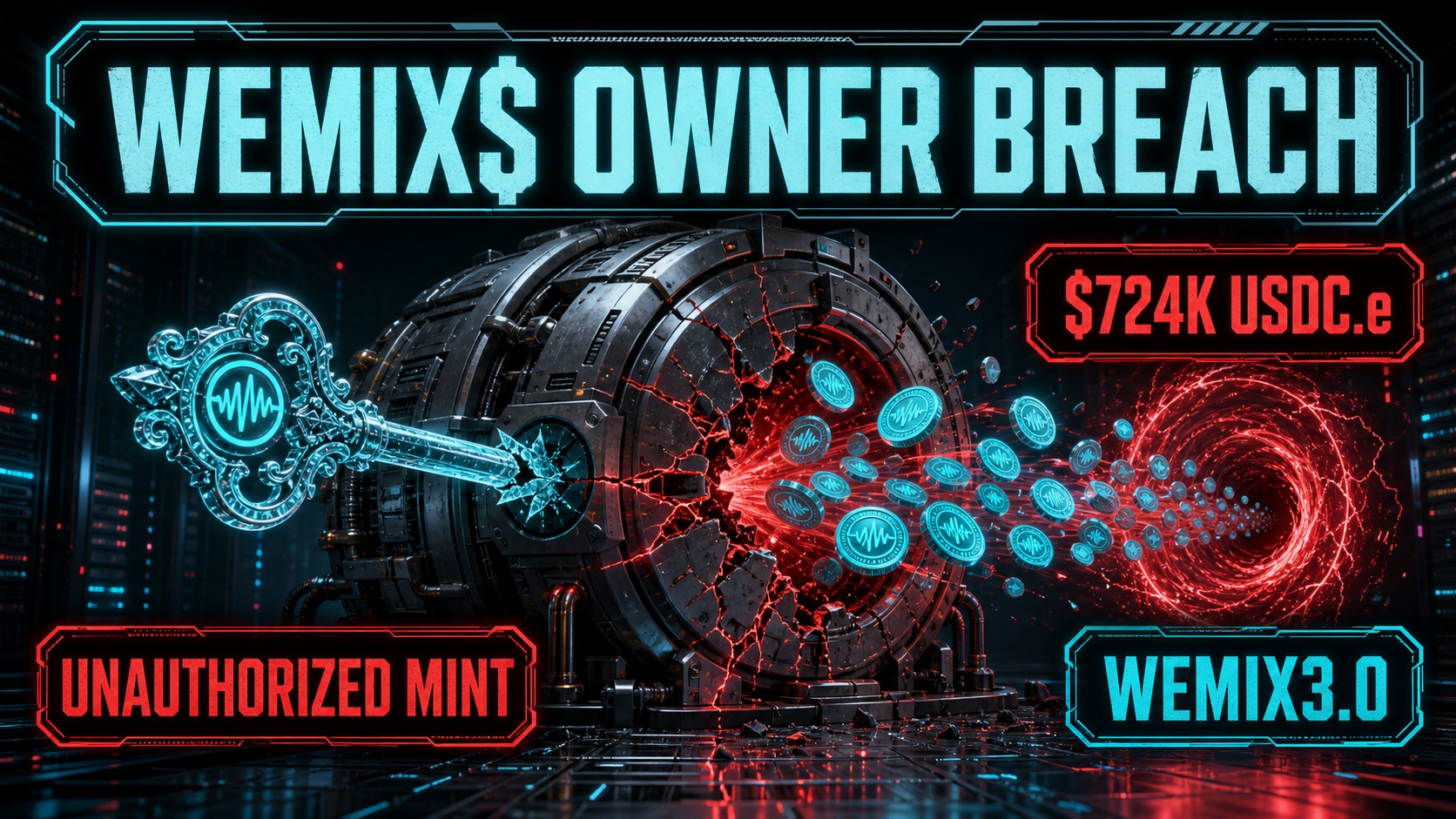
- Incident Date: July 26, 2026
- Target: WEMIX$ / WEMIX3.0
- Target Overview: WEMIX3.0 is a Layer 1 blockchain ecosystem operated by the blockchain arm of South Korean gaming company Wemade. WEMIX$ is its dollar-denominated stablecoin, which was being transitioned toward USDC.e across WEMIX3.0 services and liquidity pools in 2026.
- Total Loss: Approximately $724,198 in USDC.e directly transferred externally; a broader preliminary impact estimate of approximately $6.25 million included the unauthorized issuance
- Reported Signer Address:
0xc921a66e30745f11f8c7a7870e95640607ae7ea2 - Reported Router Contract:
0xb6bdea4941f6fd4ea3918fac902494da100ac4d2 - Reported Mint Receiver:
0xd2947dbfdbdbb99702de6e46c63cb1968e21d95b - Affected WEMIX$ Contract:
0x8e81fcc2d4a3baa0ee9044e0d7e36f59c9bba9c1 - Exploit Transaction:
0xfed2172a508d84f63b56acc7e3c30164930220004f808799998b8201fe7cefe0 - Attack Vector: Contract owner-privilege compromise / unauthorized mint
Incident Review & Technical Details
1. Attack Path
- The attacker obtained WEMIX$ owner privileges: WEMIX reported that abnormal activity began at 18:17 KST (09:17 UTC) on July 26, 2026 after ownership of a WEMIX$-related contract was compromised. The project has not yet disclosed how the attacker acquired that authority, so the initial access method remains under investigation.
- Compromised authority enabled an unauthorized mint: WEMIX's preliminary disclosure recorded approximately 5,225,525 WEMIX$ issued without authorization. DEXTools independently decoded nine mint events in the exploit transaction and calculated 10.47 million WEMIX$ in aggregate, meaning the official and independent mint totals have not yet been reconciled.
- A router coordinated the mint and conversion: DEXTools labeled
0xc921...7ea2as the transaction signer,0xb6bd...4d2as the router used to orchestrate the operation, and0xd294...d95bas the address that received the newly issued WEMIX$. These labels come from DEXTools' on-chain analysis rather than a final WEMIX attribution report. - Unauthorized WEMIX$ was sold into ecosystem liquidity: WEMIX stated that the issued stablecoins were converted into approximately 30,736 WEMIX and 724,198.27 USDC.e. DEXTools separately traced approximately 723,294 USDC.e reaching the signer address, closely aligning with the project's direct USDC.e outflow figure.
- The proceeds moved across chains: The converted USDC.e left WEMIX3.0 through bridges to Ethereum and BNB Chain, where it was exchanged into assets including ETH and USDT and distributed across additional addresses. WEMIX also reported that a portion reached centralized exchanges.
- WEMIX imposed an ecosystem-wide service lockdown: The Foundation suspended every bridge connected to WEMIX3.0, including Chainlink CCIP and PLAY Bridge, halted trading in affected liquidity pools, withdrew Foundation-supplied liquidity, and paused the WEMIX$ Module, PNIX DEX, related backends, selected game integrations, and NFT marketplace activity. The reviewed evidence describes a broad service suspension, not a halt of WEMIX3.0 block production.
2. Impact Scope
- Directly Externalized Loss: WEMIX reported 724,198.27 USDC.e converted and moved externally. DEXTools measured approximately 723,294 USDC.e reaching the signer; this article uses the project's approximately $724,198 figure as the canonical direct-loss estimate.
- Broader Impact Estimate: Coin Bureau and multiple publications reported the incident as approximately $6.25 million. That headline figure incorporates the unauthorized WEMIX$ issuance and broader network impact rather than only the USDC.e directly traced to the attacker, so it should not be treated as equivalent to verified realized proceeds.
- Unauthorized Supply Discrepancy: WEMIX's preliminary notice cited approximately 5.23 million WEMIX$, while DEXTools reported that nine mint logs in the same transaction summed to 10.47 million WEMIX$. A final project post-mortem is required to reconcile the two scopes.
- Cross-Chain Exposure: Proceeds traveled from WEMIX3.0 to Ethereum and BNB Chain before further swaps and distributions, expanding the number of bridges, stablecoin issuers, exchanges, and chain-analysis teams required for containment.
- Operational Disruption: Bridges, selected liquidity pools, the WEMIX$ Module, PNIX DEX, backend services, some blockchain-integrated game content, and WEMIX PLAY marketplace functions were suspended or restricted.
- Prior-Incident Context: The compromise followed the separate February 2025 PLAY Bridge Vault exploit, in which approximately 8.65 million WEMIX was withdrawn. The two incidents involved different affected components, and the reviewed sources do not establish a shared initial access path.
3. Official Statements
- WEMIX: In its official incident update, WEMIX confirmed the owner-privilege compromise, preliminary issuance and conversion figures, cross-chain fund movement, service suspensions, contract reviews, and asset-freeze requests. The Foundation cautioned that the facts and figures could change as the investigation progresses.
- Coin Bureau: Coin Bureau reported the incident using the approximately $6.25 million headline figure and said WEMIX was coordinating with exchanges, security firms, and law enforcement to trace the funds.
- DEXTools: DEXTools published an independent transaction-level reconstruction, identifying the signer, router, mint receiver, token contract, mint-event total, and approximately 723,294 USDC.e payout.
4. Investigation Progress
WEMIX said it had identified the attacker's addresses and was tracking the fund flow. The Foundation requested assistance and freezes from multiple global exchanges and stablecoin issuers, and reported that some exchanges had already frozen addresses associated with the attacker.
The public evidence identifies the primary transaction and several involved addresses, but the most important root-cause question remains open: WEMIX has not disclosed whether contract ownership was lost through a leaked key, compromised signer device, unsafe deployment or upgrade process, access-control misconfiguration, insider action, or another mechanism.
The response should therefore continue on two tracks:
- Preserve the signer, deployment, upgrade, key-vault, endpoint, authentication, and administrator audit trails needed to determine how owner authority changed hands.
- Reconcile the official 5.23 million WEMIX$ issuance figure with the 10.47 million WEMIX$ calculated from transaction logs.
- Trace the Ethereum and BNB Chain branches through subsequent swaps, bridges, wallets, and centralized-exchange deposits.
- Maintain freeze coordination with exchanges and stablecoin issuers while documenting which assets and addresses have actually been restricted.
- Replace or revoke the compromised owner authority and validate every contract with the same ownership, signer, upgrade, or mint-control structure before restoring services.
- Publish a final post-mortem covering the initial access vector, ownership timeline, complete unauthorized issuance, realized loss, recovery status, and long-term privileged-access redesign.
AUTOSEC.DEV Solution
WEMIX$ shows that a stablecoin's owner role is itself critical financial infrastructure: once that authority can mint, route, and externalize value, containment must span contracts, bridges, exchanges, and operator systems.
- Security Strategy & Planning — The compromised WEMIX$ owner privilege reportedly enabled unauthorized issuance before a network-wide bridge and service lockdown became necessary. AUTOSEC.DEV designs privileged-control architectures with threshold signing, hardware-backed and isolated signer paths, timelocked ownership changes, independent mint limits, role separation, real-time authority monitoring, and tested emergency revocation procedures.
- Incident Response — The WEMIX$ proceeds crossed from WEMIX3.0 into Ethereum and BNB Chain, were converted into assets including ETH and USDT, and partially reached centralized exchanges. AUTOSEC.DEV supports signer-environment forensics, transaction reconstruction, multi-chain tracing, attacker-address labeling, evidence preservation, and coordinated freeze requests with bridges, stablecoin issuers, exchanges, and law enforcement.