Vercel Supply-Chain Breach: Context.ai OAuth
Compromise Forces Web3 Teams into Emergency API Key Rotation
A compromise of Context.ai's Google Workspace OAuth app let attackers pivot into a Vercel employee's account, exposing internal Vercel systems and a limited subset of customer environment variables that were not marked 'sensitive.' Web3 teams hosting frontends, RPC proxies, and webhook handlers on Vercel are racing to rotate API keys, signer credentials, and database connection strings.
 AUTOSEC.DEV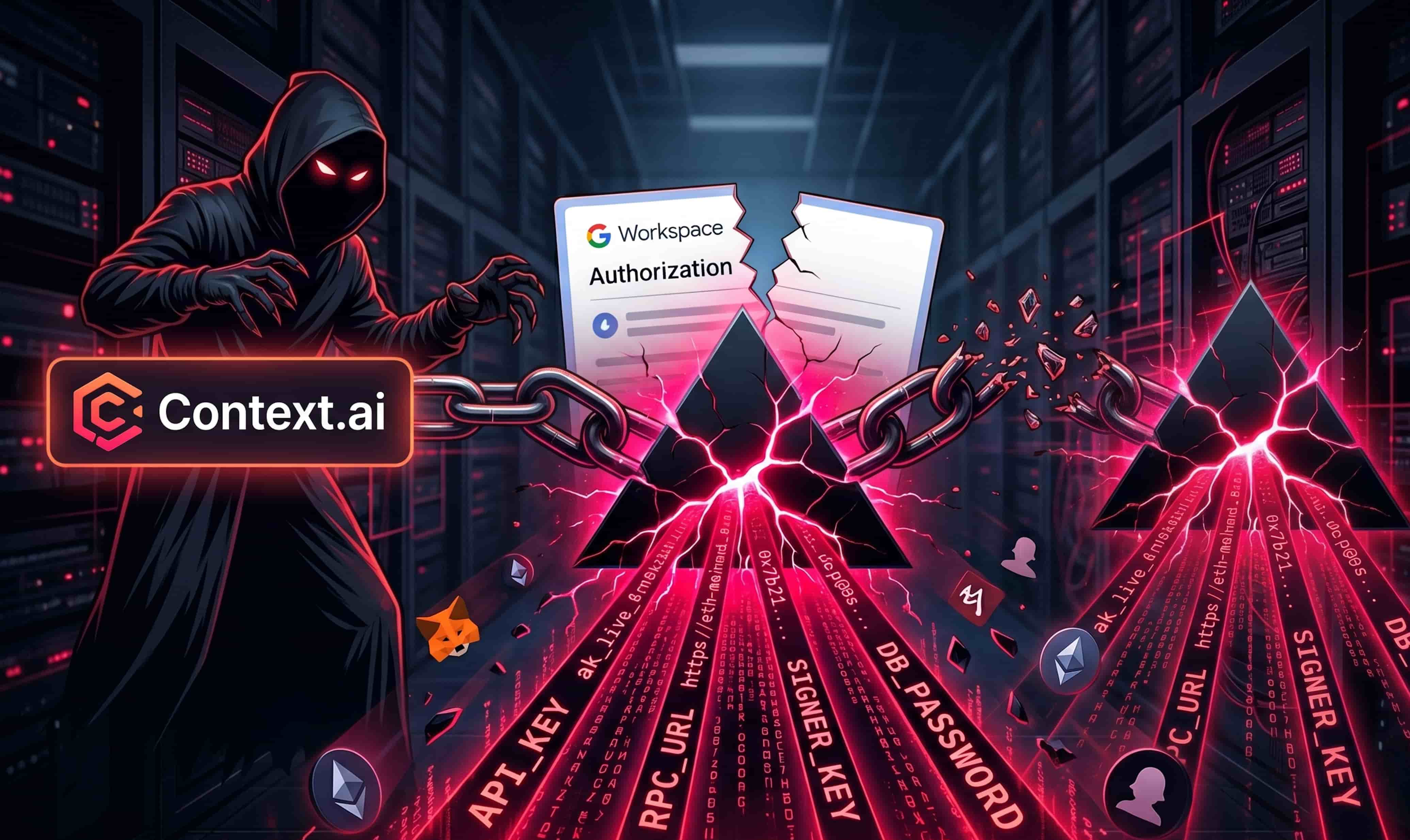
- Incident Date: April 19, 2026 (disclosure); IOC published 11:04 AM PST, attack origin and customer guidance disclosed 6:01 PM PST
- Target: Vercel (PaaS deployment platform)
- Target Overview: Vercel is one of the dominant deployment platforms for modern web applications and hosts a substantial share of Web3 frontends — DEX UIs, NFT marketplaces, governance portals, indexer dashboards, and developer tooling. Customer projects routinely store third-party API keys, RPC endpoints, and webhook secrets as Vercel environment variables.
- Scope of Compromise: Internal Vercel systems + a limited subset of customer environment variables not flagged as "sensitive" + Vercel account credentials of a limited subset of customers (individually notified)
- Attack Vector: Supply Chain Compromise via Third-Party OAuth Hijack
- Upstream Origin: Compromise of Context.ai's Google Workspace OAuth application
Incident Review & Technical Details
1. Attack Path
- Upstream Compromise at Context.ai: Attackers compromised the Google Workspace OAuth application operated by Context.ai, a third-party AI tool. According to Vercel, "Context.ai's Google Workspace OAuth app was the subject of a broader compromise, potentially affecting its hundreds of users." The malicious OAuth client was published as App ID
110671459871-30f1spbu0hptbs60cb4vsmv79i7bbvqj.apps.googleusercontent.comand has since been removed. - OAuth Pivot into Vercel Employee Account: A Vercel employee had granted Context.ai's OAuth app access to their Google Workspace account. The OAuth scopes proved sufficient for the attacker to hijack the employee's Workspace identity, bypassing standard MFA-protected login flows because OAuth tokens act as a separate, persistent authentication path.
- Lateral Movement into Internal Vercel Systems: Using the hijacked Workspace account, the attacker gained access to certain internal Vercel systems. Vercel CEO Guillermo Rauch publicly described the attackers as demonstrating "surprising velocity and in-depth understanding of Vercel," suggesting either prior reconnaissance or familiarity gained during the access window.
- Environment Variable Read on Customer Projects: The attacker enumerated environment variables across a limited subset of customer projects. Variables marked sensitive — a Vercel feature rolled out in February 2024 that stores values in a write-only form — were protected and could not be read. Variables that pre-dated the feature, or that customers had not opted in to flag as sensitive, were exposed in plaintext.
- Direct Customer Credential Exposure: Vercel separately confirmed that "a limited subset of customers" had their Vercel account credentials compromised. Those customers have been individually notified.
2. Impact Scope — Why Web3 Teams Should Treat This as Their Incident
Vercel hosts a non-trivial share of Web3 frontends and ancillary infrastructure. Any project deploying on Vercel that did not mark environment variables as sensitive should assume the following classes of secrets may have been read by the attacker:
- RPC provider keys: Alchemy, Infura, QuickNode, Ankr, BlockPI, Chainstack — leaked keys allow attacker-funded RPC quota burn and request inspection.
- Indexer / data API keys: The Graph (Studio API keys), Goldsky, Subsquid, Dune API tokens.
- Wallet service keys: Privy, Dynamic, Web3Auth, Magic, thirdweb client/secret keys — high blast-radius if secret keys can mint sessions or sign on behalf of users.
- Database & infra credentials: Supabase service-role keys, Neon / PlanetScale connection strings, Upstash Redis tokens, MongoDB Atlas URIs.
- Webhook signing secrets: Stripe, Alchemy Notify, QuickNode Streams, custom relayer webhooks. Forged webhooks can trigger off-chain state changes.
- Backend signer / relayer credentials: API keys for Defender (OpenZeppelin), Gelato, Biconomy meta-transaction relayers; in some early-stage projects, raw private keys or mnemonics stored as env vars (anti-pattern but historically observed).
- Fiat on-ramp / KYC partner keys: MoonPay, Transak, Persona, Sumsub — exposure here can enable fraudulent attribution or KYC bypass attempts.
For a project that pre-dated Vercel's February 2024 sensitive-flag rollout and never re-classified its secrets, every variable in every environment is in scope.
3. Official Statements
- Vercel (security bulletin): Confirmed the incident originated from a compromise of Context.ai used by a Vercel employee. Vercel stated environment variables marked sensitive remained inaccessible to the attacker, and only a limited subset of customers had Vercel credentials directly compromised.
- Guillermo Rauch (Vercel CEO): Acknowledged that the attackers operated with "surprising velocity and in-depth understanding of Vercel."
- Context.ai: Confirmed via Vercel's bulletin that its Google Workspace OAuth app was hit by a broader compromise potentially affecting hundreds of users. As of disclosure, no standalone Context.ai post-mortem has been linked from Vercel's advisory.
4. Indicators of Compromise
OAuth App ID (Context.ai, since deleted):
110671459871-30f1spbu0hptbs60cb4vsmv79i7bbvqj.apps.googleusercontent.com
Workspace administrators across all organizations — not only Vercel customers — should audit Google Workspace OAuth grants for the App ID above and revoke any matching grants. Context.ai's broader user base is the wider blast radius; the Vercel breach is the highest-profile downstream incident, not necessarily the only one.
5. Required Customer Actions
Per Vercel's bulletin, every Vercel customer (not only those individually notified) should:
- Review activity logs for suspicious deployments, environment variable reads, or team-membership changes during the access window.
- Rotate all environment variables containing secrets — API keys, tokens, database credentials, signing keys — across every project and every environment (Production, Preview, Development).
- Enable the sensitive environment variable flag going forward for any value that should never be readable post-creation.
- Investigate recent deployments for unauthorized commits, modified build commands, or injected post-build scripts.
- Set Deployment Protection to Standard at minimum, and rotate any Deployment Protection bypass tokens that were configured.
For Web3 teams specifically: assume any signer key, mnemonic, or relayer credential stored in an unflagged env var is compromised, move funds out of corresponding hot wallets immediately, and rotate before re-deploying.
AUTOSEC.DEV Solution
Supply-chain breaches that traverse third-party SaaS → identity provider → deployment platform → customer secrets cannot be stopped with smart-contract audits alone — they need attack-surface visibility over every third-party tool a developer connects to a corporate identity, and a rotation playbook ready before the disclosure email arrives.
- Attack Surface Analysis — The Vercel incident chained four systems (Context.ai → Google Workspace → Vercel internal → customer env vars) before reaching any customer-owned asset. Our Attack Surface Analysis enumerates the full inventory of third-party OAuth grants, deployment-platform integrations, and exposed environment variables across a Web3 team's hosting footprint, flagging high-blast-radius integrations (RPC keys, signer credentials, webhook secrets) before they leak through the next supply-chain link.
- Incident Response — For Web3 teams who deployed on Vercel and are now uncertain whether their RPC keys, Privy secrets, or relayer credentials were exfiltrated, we provide rapid env-var rotation playbooks, fund-flow monitoring on impacted hot wallets, and forensic review of recent Vercel deployments to detect attacker-injected build steps. First response within two hours.
- Security Awareness Training — The Vercel breach's initial access was a single employee granting OAuth scopes to a third-party AI tool. We deliver developer-targeted training on OAuth scope hygiene, third-party SaaS approval workflows, and Workspace-level OAuth grant auditing — closing the human-layer gap that supply-chain attackers consistently exploit.
Service Links
- AUTOSEC.DEV — Attack Surface Analysis
- AUTOSEC.DEV — Incident Response
- AUTOSEC.DEV — Security Awareness Training
Reference
- Vercel — April 2026 Security Incident Bulletin
- The Hacker News — Vercel Breach Tied to Context.ai Hack
- CoinDesk — Hack at Vercel Sends Crypto Developers Scrambling to Lock Down API Keys
- Hacker News discussion — Vercel security incident
- r/cybersecurity — Vercel disclosed a security incident today (April 19)