Ostium Oracle Exploit: Up to
$18M Drained via Future-Dated Prices
Up to $18 million in USDC was reportedly drained from Ostium after a registered PriceUpKeep forwarder submitted authorized, future-dated oracle reports on Arbitrum.
 AUTOSEC.DEV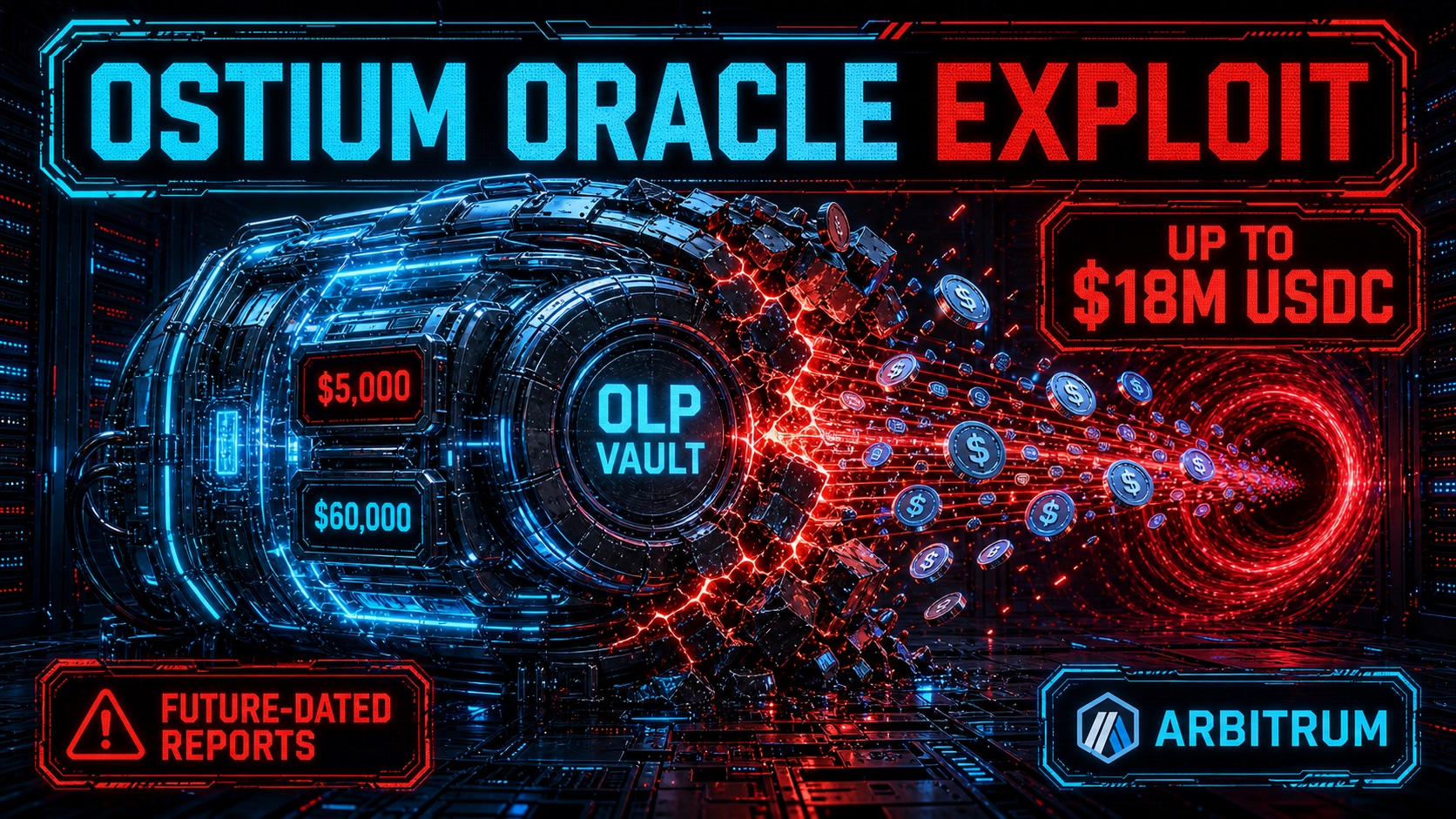
- Incident Date: July 15, 2026
- Target: Ostium
- Target Overview: Ostium is an Arbitrum-based decentralized perpetuals exchange for crypto and real-world assets, including commodities, forex, and equity indices. Its USDC-denominated OLP vault supplies the counterparty liquidity used to settle traders' profits.
- Total Loss: Up to approximately $18 million in USDC, according to Blockaid; approximately 11.86 million USDC is directly visible in the primary exploit transaction, and Ostium has not yet published a reconciled total
- Reported Recipient Address:
0x321Df194646029e7A6193Ea05573d4B9c398bfD9 - Primary Exploit Transaction:
0x359f8c05b86a4409d60cfba02084334313fd94b19f74a294fb7fc4ea7d4870e0 - Attack Vector: Oracle manipulation
Incident Review & Technical Details
1. Attack Path
- The attacker gained an authorized path into the price-update system: Blockaid reported that the attack used a registered
PriceUpKeepforwarder together with authorized oracle reports carrying future timestamps. The reports therefore entered Ostium through infrastructure the protocol treated as trusted, rather than through an ordinary unprivileged price submission. - The authorization layer accepted attacker-controlled reports: ExVul's preliminary analysis said the attacker's forwarder was already registered and the reports recovered to an authorized oracle signer. Because the relevant forwarder and signer permissions cannot be self-granted by an arbitrary account, ExVul assessed that a privileged oracle or forwarder key had likely been compromised. Ostium has not yet confirmed whether a signer key, forwarder key, or another authorization control was the initial point of failure.
- Future-dated prices manufactured profitable trades: In the primary Arbitrum transaction, the sender
0xD179...85869calledexecuteBatchthrough0xfE12...5bd2E. The batch alternated calls into Ostium's trading and private price-upkeep components, opening and closing positions against prices supplied inside the same operation. Independent transaction analysis identified BTC/USD as the affected pair, with positions opened at a fabricated price of approximately $5,000 and closed near $60,000. - The vault settled artificial profit in USDC: The primary transaction began with approximately 1,000 USDC and caused Ostium's vault to send approximately 11,862,445 USDC, of which
0x321D...bfD9received approximately 11,861,520 USDC. Blockaid attributed additional related payouts to the same exploit pattern and estimated the total at up to approximately $18 million in USDC.
2. Impact Scope
- Protocol-Level Loss: Blockaid estimated that the oracle manipulation extracted up to approximately $18 million in USDC from the OLP vault. The primary transaction establishes an on-chain floor of approximately $11.86 million, while the final aggregate remains subject to Ostium's reconciliation.
- Liquidity-Provider Exposure: OLP liquidity providers supply the vault that pays winning traders. Artificial profit was therefore converted directly into a loss for the protocol's counterparty-liquidity pool.
- Share of Protocol Liquidity: DefiLlama data cited by The Defiant placed Ostium's TVL near $63.3 million before the attack. The approximately $18 million top-end estimate would equal roughly 28% of that pre-incident TVL, although TVL and the balance of the specifically affected vault are not identical measures.
- Protocol Availability: Ostium paused all trading after detecting the OLP vault issue. No reviewed source reported a compromise of Arbitrum itself or a loss from unrelated protocols.
3. Official Statements
- Ostium: The protocol acknowledged an issue with the OLP vault, paused all trading, and said the team was investigating. Its initial notice did not provide a root cause, final loss figure, recovery plan, or reopening timetable.
- Blockaid: The security firm reported that a registered
PriceUpKeepforwarder and future-dated authorized oracle reports created artificial trade profit and triggered an approximately $18 million USDC payout.
4. Investigation Progress
As of July 16, 2026, Ostium had not published a full technical post-mortem or reconciled the difference between the approximately $11.86 million directly visible in the primary transaction and Blockaid's approximately $18 million aggregate estimate. The protocol had also not announced whether OLP depositors would be reimbursed or when trading might resume.
The central unresolved question is how the attacker acquired an authorized price-submission path. The transaction proves that manipulated prices reached settlement and that the vault paid the resulting profit, but it cannot by itself distinguish among compromise of an oracle signer, compromise of a registered forwarder, or a defect in how authorized reports and timestamps were validated. No confirmed recovery or fully traced laundering route was identified in the reviewed sources.
AUTOSEC.DEV Solution
The Ostium exploit shows that an oracle's security boundary includes signer custody, forwarder authorization, report validation, and the on-chain limits applied before a vault honors the resulting price.
- Secure Code Review - Ostium's settlement path accepted future-dated reports that drove BTC/USD from approximately $5,000 to $60,000 inside the attack workflow. AUTOSEC.DEV reviews oracle adapters, signature verification, timestamp and nonce handling, forwarder permissions, and price-deviation checks to ensure authenticated data is still rejected when it is stale, future-dated, duplicated, or economically impossible.
- Security Strategy & Planning - A trusted price-submission path was able to reach a vault with no effective payout brake before up to approximately $18 million left the protocol. For perpetual exchanges, AUTOSEC.DEV designs separation between signers and automation operators, hardened key custody, independent reference feeds, per-market payout caps, deviation limits, and circuit breakers tied to vault exposure.
- Penetration Testing - The primary exploit batched attacker-selected prices and trade settlement into one transaction. AUTOSEC.DEV reproduces compromised-signer, malicious-forwarder, future-timestamp, and extreme-price scenarios on a fork to verify that the complete trading stack fails closed before manipulated profit can be paid from liquidity-provider funds.
Service Links
- AUTOSEC.DEV - Secure Code Review
- AUTOSEC.DEV - Security Strategy & Planning
- AUTOSEC.DEV - Penetration Testing