Renegade V1 Arbitrum Dark Pool Exploit:
$209K Drained, $190K Returned After Whitehat Negotiation
Renegade's legacy V1 Arbitrum dark pool was exploited for about $209,000 after a deployment and migration issue left ownership and initialization controls exposed. The attacker later returned roughly $190,000, and Renegade said affected users would be fully compensated.
 AUTOSEC.DEV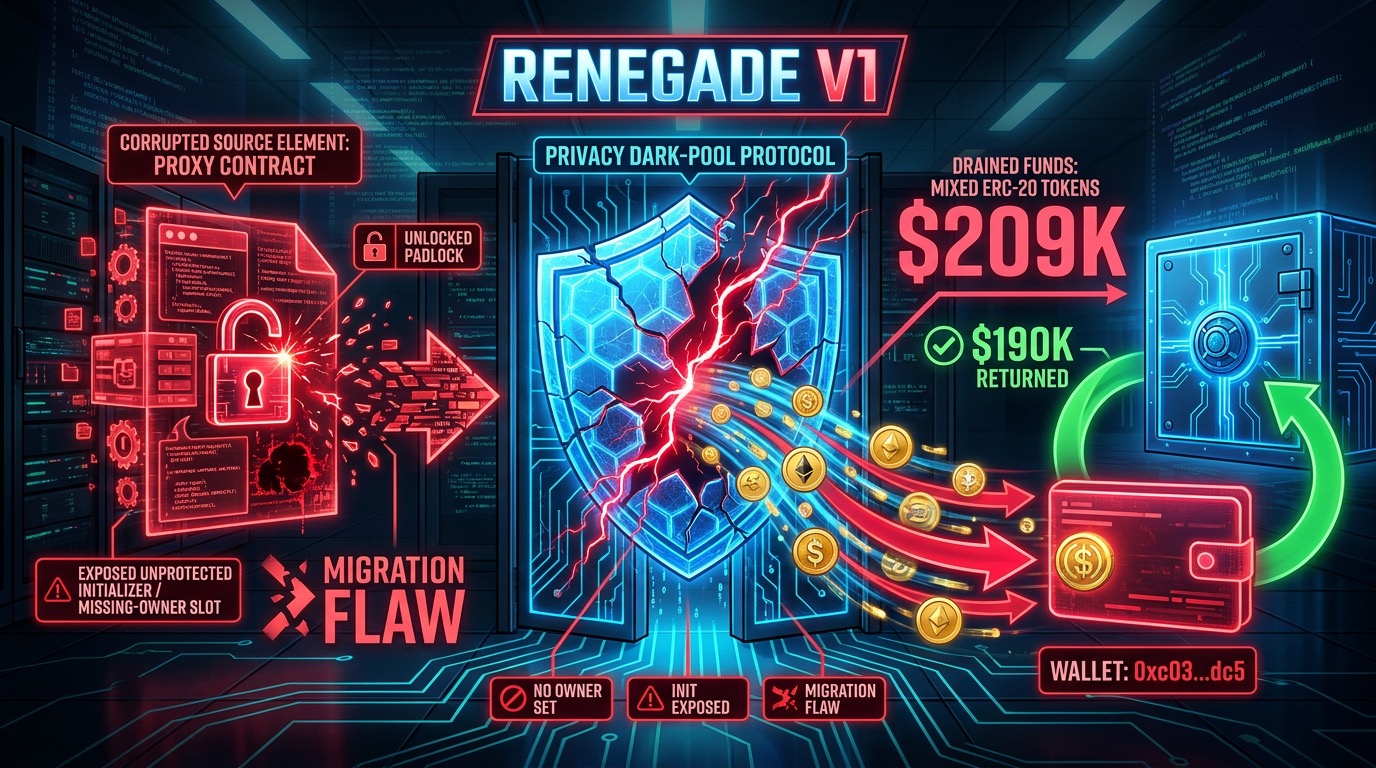
- Incident Date: May 11, 2026
- Target: Renegade V1 dark pool deployment on Arbitrum
- Target Overview: Renegade is a privacy-focused on-chain dark pool for non-custodial token swaps. Public statements and reporting scoped this incident to the legacy V1 Arbitrum deployment, while Renegade stated that V1 Base, V2 Arbitrum, and V2 Base were not affected.
- Total Loss: ~$209,000 gross, with ~$190,000 returned
- Attack Vector: Proxy Ownership Misconfiguration / Unprotected Initialization / Faulty Migration
Incident Review & Technical Details
1. Attack Path
- Legacy Deployment Became the Exploit Surface: The incident affected Renegade's older V1 Arbitrum dark pool, which Renegade described as representing about 7% of recent trading activity. The more actively used V2 deployments were not reported as affected.
- Deployment Ownership Was Not Explicitly Assigned: Renegade's public update attributed the failure to deployment code that did not assign an explicit owner during deployment. That mistake became dangerous when paired with later migration behavior.
- Faulty Migration Reopened a Critical Control Path: Public reports describe an April 2025 migration issue that left an initialization or ownership path reachable on the legacy deployment. In practical terms, a control path that should have been permanently closed remained callable.
- Attacker Took Control of the V1 Arbitrum Logic Path: Reporting tied the exploit to the vulnerable V1 Arbitrum implementation at
0xc038933d0b33359f5C87B4B2f92Ee0DAd11EaDc5. The attacker was then able to redirect execution through malicious logic and drain assets from the affected deployment. - About $209K Was Drained Across Multiple Tokens: Public coverage reported roughly $209,000 in total losses across 27 ERC-20 tokens.
- Whitehat Return Followed On-Chain Negotiation: Renegade sent an on-chain message offering a 10% bounty. The party controlling the funds returned about $190,000, leaving a much smaller net loss after the recovery.
2. Impact Scope
- Direct Gross Loss: Approximately $209,000 was drained from the affected V1 Arbitrum deployment.
- Recovered Funds: Approximately $190,000 was returned after Renegade's recovery outreach and bounty offer.
- Affected Component: The known affected surface was Renegade's legacy V1 Arbitrum dark pool deployment and its supporting infrastructure.
- Unaffected Deployments: Renegade stated that V1 Base, V2 Arbitrum, and V2 Base were not impacted.
- User Compensation: Renegade stated that affected users would be fully compensated and that the net cost to the protocol was about $21,000 after recovered funds and bounty handling.
- Operational Response: Renegade suspended all infrastructure supporting V1 Arbitrum and said there was no ongoing risk after containment.
3. Root Cause Assessment
The incident fits a high-impact proxy and deployment-lifecycle failure:
- Initialization Was Not Irreversibly Closed: Upgradeable and proxy-based systems depend on initialization being executed exactly once and then permanently locked. Any reachable initializer-like path can become a latent takeover primitive.
- Owner Assignment Was Treated as Deployment Plumbing: Missing ownership assignment is not a cosmetic setup issue. In contracts that govern implementation pointers, resolver routing, or delegated execution, owner state is part of the asset boundary.
- Migration Expanded the Blast Radius: The April 2025 migration appears to have converted a deployment-time mistake into an exploitable production condition. Legacy deployments often accumulate risk when migrations are treated as one-time operations rather than security-critical changes.
- Low-Activity Systems Still Hold Real Value: Even though V1 Arbitrum represented a smaller share of Renegade activity, it still carried user funds and contract authority. Legacy infrastructure needs the same kill-switch, monitoring, and ownership checks as primary deployments.
Because no full function-level post-mortem had been published at the time of writing, the most reliable public conclusion is that the exploit combined a legacy V1 Arbitrum deployment issue, missing explicit ownership assignment, and a faulty migration that left a privileged control path exposed.
4. Mitigation and Response
Recommended actions for protocols operating proxy-based or legacy deployments:
- Lock implementation contracts immediately after deployment with
_disableInitializers()or an equivalent one-way initializer guard. - Verify that every proxy, implementation, resolver, and migration helper has an explicit, expected owner or admin before mainnet activation.
- Treat migrations as security events: run post-migration invariant checks for owner, implementation, admin slot, initializer state, resolver address, and pause state.
- Build negative-case tests proving that unrelated EOAs and contracts cannot initialize, upgrade, reassign ownership, or replace execution logic.
- Keep emergency pause and decommission playbooks for legacy deployments that still hold user value.
- Monitor legacy systems for abnormal ownership changes, implementation changes, token outflows, and calls to functions expected to be permanently unreachable.
AUTOSEC.DEV Solution: Building a 360-Degree Defense
Renegade's V1 Arbitrum incident is a reminder that deployment scripts and migrations are part of the security boundary. A contract can be formally correct and still become exploitable if ownership, initializer, or proxy state is wrong in production.
- Secure Code Review: AUTOSEC.DEV reviews proxy patterns, initializer guards, owner/admin assignment, migration scripts, and upgrade authorization paths before deployment.
- Deployment & Migration Security Testing: We test the full deployment lifecycle on forks and staging networks, then verify post-deployment invariants such as ownership, implementation slots, pause status, and disabled initializer state.
- Legacy Contract Risk Assessment: We identify older deployments, deprecated routers, low-activity pools, and forgotten spender or resolver paths that can still expose funds.
- Incident Response (IR): AUTOSEC.DEV supports containment, on-chain tracing, recovery negotiation support, affected-user scoping, and post-incident hardening for active DeFi exploits.
Service Content
- AUTOSEC.DEV - Secure Code Review
- AUTOSEC.DEV - Penetration Testing
- AUTOSEC.DEV - Incident Response Service